


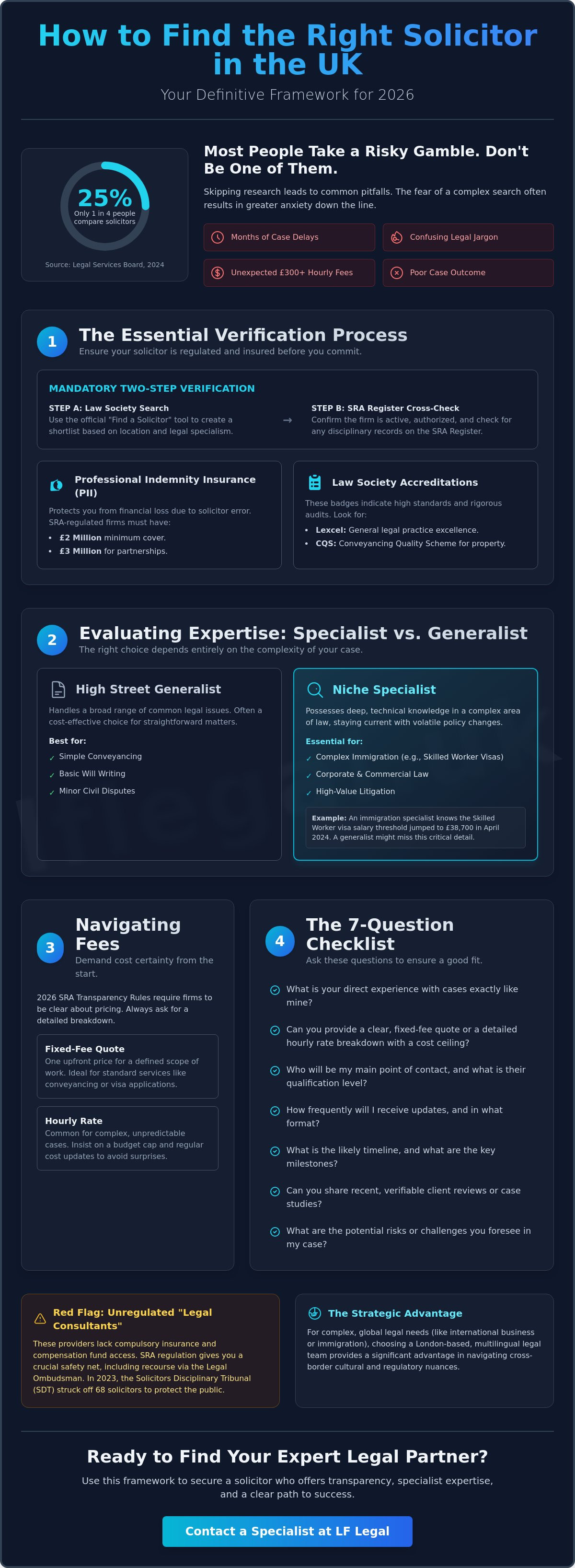
Did you know that according to the Legal Services Board’s 2024 tracker, only 25 percent of legal consumers actually compare different firms when they need to find a solicitor? It is a risky gamble when the wrong choice leads to months of case delays or unexpected invoices that break your budget. Most people simply pick the first name they see, hoping for the best while fearing the worst.
It’s completely understandable why so many people skip the research phase. When you are dealing with a high-pressure situation like a property chain or a complex immigration filing, the prospect of deciphering regulatory jargon is exhausting. The fear of hidden £300 hourly fees makes the search feel like a second job you didn’t ask for. You likely believe that legal advice should be transparent and accessible, not a source of extra anxiety.
This guide changes that by providing a definitive selection framework for the 2026 UK market. You’ll learn how to secure cost certainty from the start and identify specialists who communicate in plain English. We will examine how to verify SRA credentials, compare fixed-fee quotes, and use digital tools to ensure your legal expert has a proven track record in your specific area of law.
Key Takeaways
- Master the essential two-step verification process using the Law Society tool and SRA Register to ensure your legal representation is fully regulated.
- Understand the critical differences between high street generalists and specialist firms to ensure your specific corporate or immigration needs are met with expert precision.
- Navigate 2026 SRA transparency rules to effectively compare pricing models and manage hourly rates without encountering hidden fees.
- Use our professional 7-question checklist to find a solicitor who offers a proven success rate and clear accountability for your specific case.
- Discover the strategic advantages of choosing a London-based, multilingual legal team for managing complex, global legal requirements.
Table of Contents
- How to Find a Solicitor: The Essential Verification Steps
- Evaluating Expertise: Generalist vs. Specialist Solicitors
- Understanding Legal Fees: A Comparison of Pricing Models
- The Solicitor Selection Checklist: 7 Questions to Ask
- Why LF Legal is the Strategic Choice in London
How to Find a Solicitor: The Essential Verification Steps
Finding the right legal expert involves more than a quick search. You need a structured approach to find a solicitor while ensuring your money and interests are protected. To begin your search, use the Law Society’s official “Find a Solicitor” tool. This database lets you filter by postcode and legal specialism, which generates a shortlist of practitioners who hold a current practising certificate in the United Kingdom.
Before you commit, cross-reference every firm on the Solicitors Regulation Authority (SRA) Register. This step confirms the firm is active and authorized to provide legal services. Understanding the fundamental role of these professionals is key; if you’re unsure about the distinction between legal roles, reading up on what is a solicitor? can clarify their specific rights of audience and duties.
Verification doesn’t stop at registration. You must check for Professional Indemnity Insurance (PII). In the UK, SRA-regulated firms must carry a minimum of £2 million in cover, or £3 million for partnerships. This insurance protects you if the solicitor makes a mistake that leads to financial loss. Search for Law Society Accreditations like Lexcel for general excellence or the Conveyancing Quality Scheme (CQS) for property deals. These badges indicate the firm has passed rigorous independent audits and adheres to high management standards.
Understanding SRA Regulation and Why It Matters
You should avoid instructing an unregulated legal provider for complex matters. These “legal consultants” often lack the compulsory insurance and compensation fund access that regulated firms provide. When you view an SRA profile, check for “disciplinary records” or “closed firms.” The Solicitors Disciplinary Tribunal (SDT) acts as a court, handling cases of serious professional misconduct. In 2023, the SDT struck off 68 solicitors to maintain public trust. Using a regulated firm ensures you have recourse through the Legal Ombudsman if the service is substandard.
Where to Look Beyond Official Registers
Official data tells you a firm is legal, but reviews tell you if they’re actually good. Check Trustpilot and Google for recent client feedback from the last 12 months. Peer recommendations carry significant weight in specialist fields like immigration law, where personal success stories highlight a solicitor’s ability to handle complex Home Office nuances. Use LinkedIn to verify a specific solicitor’s career history. A practitioner with a decade of experience in your specific legal problem is usually a safer bet than a generalist. To find a solicitor who fits your needs, look for those who regularly publish updates on legal changes in their sector.
Evaluating Expertise: Generalist vs. Specialist Solicitors
Choosing the right legal partner in 2026 requires more than a quick search. While a “high street” generalist works well for simple conveyancing or basic wills, they often lack the technical depth needed for complex corporate or immigration matters. If you use The Law Society’s Find a Solicitor tool, you’ll notice hundreds of firms claiming broad expertise. However, the legal environment has become far too segmented for a one size fits all approach. Specialists in Innovator Founder or Skilled Worker visas, for example, must navigate the massive salary threshold hikes introduced in April 2024, where the minimum requirement jumped to £38,700 for many applicants.
You can test a solicitor’s knowledge during your initial enquiry by asking about recent policy shifts. A specialist will cite specific Home Office guidance or recent case law, while a generalist might offer vague generalities. Multilingual support is another critical indicator. In a global hub like London, firms that offer services in multiple languages demonstrate they regularly handle cross-border complexities and international talent mobility. It’s not just about translation; it’s about understanding the cultural and regulatory nuances of different jurisdictions.
Niche Specialisms: Immigration and Commercial Law
Immigration law is notoriously volatile. Following the major structural changes to the Immigration Rules in early 2024, staying updated on Home Office White Papers is a full-time job. A specialist ensures your application isn’t rejected due to a minor technicality in a newly updated guidance document. Similarly, commercial law for SMEs requires precision. Drafting a shareholder agreement isn’t just about filling in blanks; it involves protecting your intellectual property and preparing for future investment rounds. When disputes escalate, specialists handle Judicial Reviews with a level of procedural expertise that generalists simply can’t match, often saving clients thousands in potential costs.
The Boutique Firm Advantage
Many larger London firms operate like “legal factories” where your case is passed from a senior partner to a junior paralegal the moment the retainer is signed. Boutique firms offer a different model. You get direct access to senior solicitors who take the time to align legal strategies with your specific business goals. This personalised service is vital for bespoke immigration pathways where a single error can lead to a life-altering rejection. If you want to find a solicitor who treats your case as a priority rather than a file number, the boutique approach often yields better results. This model focuses on quality of outcome over volume of clients.
DownloadFeedback & RecreateDelete
Understanding Legal Fees: A Comparison of Pricing Models
The 2026 SRA Transparency Rules have transformed how clients find a solicitor. These regulations mandate that firms provide clear, accessible pricing for services like employment tribunals and debt recovery on their websites. You won’t have to guess the final bill anymore. Most firms now offer fixed price packages for standard tasks. For instance, standard immigration applications or property transfers usually come with a single price tag. This protects your budget from spiralling costs.
Hourly rates remain the backbone of high-stakes legal work. Managing these requires discipline. You should insist on stage-based billing. This means the solicitor bills you only after reaching specific milestones in the case. For corporate clients, the Legal Concierge model is gaining traction. By paying a monthly retainer, companies secure dedicated hours at a discounted rate compared to ad-hoc instructions. This model provides ongoing support without the friction of new engagement letters for every small query.
Fixed Fees vs. Hourly Professional Rates
Fixed fees offer cost certainty for probate in the UK and property sales. You know exactly what you’ll pay regardless of how many emails the firm sends. Hourly rates work better for complex litigation where the final destination isn’t clear. Senior solicitors in London often charge between £250 and £600 per hour. Always ask for a written fees estimate and a hard fees cap before work begins. If the solicitor reaches that cap, they can’t bill more without your express written consent.
Disbursements and Hidden Costs to Watch For
Disbursements are costs paid to third parties on your behalf. These aren’t part of the solicitor’s professional fee but are essential to your case. Common examples include:
- Court Fees: Currently £593 for a divorce application in the UK.
- Probate Fees: A flat fee of £273 for estates valued over £5,000.
- Search Fees: Often exceeding £300 for local authority property searches.
You must check if the initial quote includes 20% VAT. Some firms quote “net” prices which can lead to a 20% surprise on your final invoice. A compliant Client Care Letter should detail every potential cost. This document is your contract. If you find a solicitor who refuses to list external expenses or VAT upfront, it’s a significant red flag. Accurate budgeting in 2026 relies on this level of granular detail from the very first consultation.
The Solicitor Selection Checklist: 7 Questions to Ask
Choosing the wrong legal representative leads to delays and unexpected bills. When you attempt to find a solicitor, you aren’t just looking for a professional qualification. You’re looking for a partner who understands your specific goals. Use these four critical questions during your initial consultation to separate high-performers from the rest of the market.
- Who will actually be doing the work on my file? Senior partners often lead the initial meeting, but a junior associate or paralegal might handle the daily tasks. You should know exactly who is responsible for your case and their specific hourly rate to avoid billing surprises.
- What is your success rate with this specific type of case? Don’t settle for vague claims of experience. Ask how many cases similar to yours they closed successfully in the last 12 months. A firm that handled 45 successful litigation claims in 2025 is a safer bet than a generalist firm.
- How and how often will you communicate updates to me? Silence creates anxiety. Ask if they provide weekly email digests or if you’ll have access to a 24/7 digital case management system.
- Can you provide a total cost breakdown including all disbursements? A quote for “legal fees” isn’t the final price. You must account for VAT and disbursements. For example, a standard probate application fee in the UK is currently £300 for estates over £5,000. Ensure every external cost is listed in your written estimate.
Communication and Client Care Standards
Professional firms usually adhere to the “24-hour rule,” meaning they acknowledge all enquiries within one business day. If a firm takes 72 hours to return a call before you’ve even hired them, they’ll likely be slower once they have your deposit. Modern firms use secure client portals for document management. These systems allow you to upload IDs and sign contracts instantly, which can shave 5 to 10 days off a standard transaction. Watch for red flags like a lack of transparent pricing or pushy sales tactics that pressure you to sign on the spot.
Assessing Cultural and Language Fit
Legal jargon is difficult enough in your first language. In complex cases involving international litigation or family law, cultural nuances matter. Solicitors who speak your native language, such as Mandarin, Ukrainian, or Russian, provide an immediate advantage. They understand the specific documentation styles and social contexts of your home country, which helps speed up the evidence-gathering process. Engaging a multilingual team ensures that subtle nuances in foreign documentation are accurately translated, which significantly reduces the risk of miscommunication or errors in formal legal filings. This is particularly vital when you find a solicitor to handle sensitive residency applications.
Ready to move forward with a team that understands your specific needs? Contact LF Legal today for expert guidance on your next steps.
Why LF Legal is the Strategic Choice in London
LF Legal stands as a premier choice for those looking to find a solicitor who combines local expertise with a global perspective. Situated in Piccadilly, our SRA-regulated practice provides the security of strict regulatory compliance. The Solicitors Regulation Authority (SRA) oversees over 150,000 solicitors in England and Wales; we strictly adhere to the standards set in their 2019 Code of Conduct. Our multilingual team bridges cultural gaps, offering tailored legal strategies to a diverse international clientele. We understand that legal costs are a primary concern for many. Data from the Legal Services Board suggests that price transparency is a top priority for 70% of legal consumers. To address this, we provide transparent pricing through fixed-fee arrangements and bespoke retainer models. Our Legal Concierge Service offers continuous, high-level support for high-net-worth (HNW) individuals and corporate entities requiring priority access to legal counsel.
Specialist Support for Immigration and Business
Our team delivers results for complex immigration services, including Skilled Worker and Innovator Founder visa routes. Statistics from the Home Office for the year ending June 2023 showed a 33% rise in work-related visas, making expert guidance essential for a successful application. Beyond immigration, we provide robust commercial support. We handle everything from drafting shareholder agreements to managing debt recovery processes. We strip away the complex legal jargon. Our goal is to ensure you understand every step of your case without the confusion of archaic terminology. This approach ensures you remain in control of your legal strategy at all times.
Next Steps: How to Start Your Legal Journey
Starting your case is straightforward. You can book an initial consultation at our Piccadilly office or via a secure video call. To maximize the efficiency of your first meeting, please prepare your valid passport, proof of address, and any relevant financial statements or correspondence related to your case. Having these documents ready can reduce initial administrative time by approximately 40%. It’s the most effective way to help your legal team assess your position quickly and accurately. If you want to find a solicitor who prioritizes your specific needs, our intake team is ready to assist. Find a solicitor who speaks your language—contact LF Legal today.
Secure Your Legal Future with Confidence
Navigating the UK legal landscape in 2026 requires more than just a quick search. You must verify credentials through the Solicitors Regulation Authority and determine whether a fixed-fee or hourly model aligns with your financial goals. Choosing the right legal partner means looking beyond the surface. It’s about finding a firm that balances deep specialist expertise with absolute pricing transparency. When you’re ready to find a solicitor, prioritize professionals who offer clear communication and a proven track record in the London market.
LF Legal provides this exact level of strategic support from our central office at 180 Piccadilly, London. We’re fully SRA Regulated (No. 654632) to ensure your protection and peace of mind. Our team bridges global communication gaps by offering expert support in English, Ukrainian, Russian, and Mandarin. You don’t have to navigate complex legal hurdles alone. Our experts are ready to guide you through every step of the process with clarity and precision. Your legal success starts with making an informed choice today.
Book a consultation with our expert London solicitors and let’s discuss your specific needs. We’re here to help you move forward.
Frequently Asked Questions
How do I check if a solicitor is genuine and regulated?
You can verify a legal professional’s credentials by searching the Solicitors Regulation Authority (SRA) digital register. This database lists every firm and individual solicitor authorised to practice in England and Wales. You should also look for the SRA regulated clickable badge on their website footer. In 2023, the SRA reported over 200,000 solicitors on the roll, so checking this list ensures you’re dealing with a legitimate professional.
What is the difference between a solicitor and a barrister?
A solicitor handles your daily legal affairs and case preparation, while a barrister typically provides specialist advocacy in court. You’ll usually hire a solicitor first to manage your legal matter from start to finish. If your case goes to a high-level hearing, your solicitor will likely instruct a barrister to present the oral arguments. This division of labour is a standard feature of the UK legal system.
Can I change my solicitor if I am unhappy with their service?
You have a legal right to change your legal representative at any point during your case. To find a solicitor who better fits your needs, you simply instruct a new firm to request your files from the previous one. Be aware that you’ll still need to pay for any work completed up to that date. According to the Legal Ombudsman, thousands of clients switch providers annually to improve communication or expertise.
How much does it cost to find a solicitor for a visa application?
Fixed fees for a standard UK Spouse Visa or Skilled Worker Visa application typically range between £800 and £2,500 excluding VAT. Complex cases involving appeals or human rights claims often cost more. According to 2024 Law Society data, hourly rates for immigration specialists start at approximately £150 in smaller towns. Always ask for a written quote before committing to any legal service.
What should I do if I have a complaint about my solicitor?
You must first follow the firm’s formal internal complaints procedure, which they’re required to provide in writing. If the issue isn’t resolved within eight weeks, you can escalate the matter to the Legal Ombudsman. This independent body handled 10,743 complaints in the 2022/23 period. They can order the firm to compensate you or provide an apology if they find service standards weren’t met.
Do I need a local solicitor, or can I hire one from anywhere in the UK?
You can hire a solicitor from any location in the UK because most legal work is now conducted via email and video calls. To find a solicitor with the best expertise, you don’t need to limit your search to your local high street. However, for specific matters like local planning disputes or criminal court appearances, a local professional might save you travel costs. Digital platforms make remote collaboration seamless in 2026.
Is a solicitor required for residential property conveyancing in 2026?
While it’s technically possible to do your own conveyancing, almost all UK mortgage lenders require a solicitor or licensed conveyancer to protect their interests. In 2024, HM Land Registry processed over 1 million property transactions, and the vast majority involved legal professionals. Attempting a DIY transfer is risky because you’ll be personally liable for any errors in the deeds or search reports.
What is a “Legal Concierge” service and do I need it?
A Legal Concierge is a managed service that identifies and vets the most suitable legal experts for your specific case. These services act as a bridge between you and the law firm, often providing a single point of contact. You might find this helpful if you have a complex multi-jurisdictional issue or simply don’t have the time to vet multiple firms yourself. It streamlines the selection process significantly.
