


Applying for a UK visa in 2026 isn’t just a paperwork exercise; it’s a high-stakes financial investment where a single £100 calculation error can result in the total loss of your non-refundable application fees. You’re likely feeling the pressure of rising Home Office costs and the dread of losing thousands of pounds to an avoidable rejection. It’s frustrating when the official price tag doesn’t reflect the true cost of skilled worker visa uk once you factor in the £1,035 annual Immigration Health Surcharge and fast-track priority service fees.
This solicitor-verified guide breaks down every mandatory expense for 2026, from the £200 Immigration Skills Charge to the specific discounts available if your role is on the Immigration Salary List. We’ll map out a line-by-line budget including hidden legal costs and clarify exactly which fees your employer is legally required to cover so you don’t pay a penny more than necessary. By the end of this breakdown, you’ll have a clear roadmap to secure your sponsorship without any expensive financial surprises.
Key Takeaways
- Learn the 2026 statutory fee differences between short-term and long-term stays, including the price variations for applications made inside versus outside the UK.
- Calculate mandatory “hidden” expenses such as the updated Immigration Health Surcharge (IHS) and the specific maintenance funds required for a successful application.
- Understand the total cost of skilled worker visa uk sponsorship for employers, covering Certificate of Sponsorship (CoS) issuance and the tiered Immigration Skills Charge.
- Discover strategic ways to lower your financial commitment, including eligibility for the Health and Care Worker fee waiver and choosing the right duration to manage cash flow.
- Find out why investing in fixed-fee legal representation is more cost-effective than a “DIY” failure, protecting you from the high price of a rejected application.
Table of Contents
- Primary Application Fees: The 2026 Statutory Costs
- The “Hidden” Personal Costs: Beyond the Application Form
- The Employer’s Bill: Sponsorship Levies and Charges
- Strategic Cost Management: Reducing the Financial Burden
- Professional Legal Fees: Why Fixed-Fee Representation Pays Off
Primary Application Fees: The 2026 Statutory Costs
Understanding the current fee structure is the first step for any migrant or employer planning a sponsorship route. The Home Office updated these figures in early 2026 to reflect rising administrative costs and inflation. To grasp why these charges exist, it helps to look at the history of UK work permits, which shows a transition from simple employment letters to the complex, points-based system used today. Calculating the total cost of skilled worker visa uk depends on two main factors: where you’re applying from and how long you intend to stay.
The government divides fees into two duration brackets. You’ll pay less for a visa lasting up to 3 years and significantly more for any stay exceeding that period. These costs apply to the main applicant and each individual dependant, meaning a family of four can face substantial upfront expenses before even arriving in the country.
Standard Application Fee Tiers
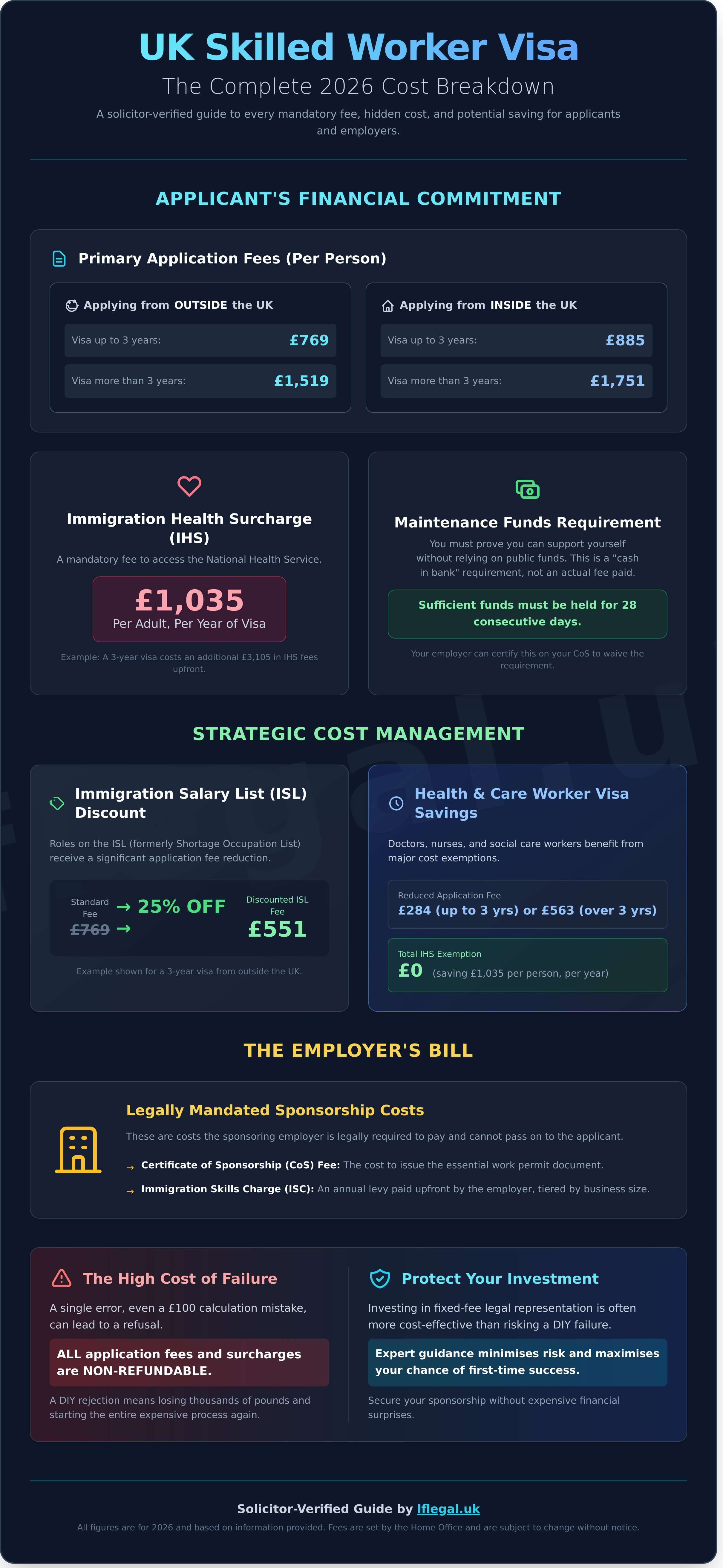
Applying from outside the UK is generally cheaper than switching or extending from within the country. For a Skilled Worker visa lasting up to three years, the application fee is £769 per person. If the visa duration exceeds three years, the fee increases to £1,519 per person. These fees do not include the Immigration Health Surcharge or biometric enrolment costs.
If you are already in the UK and wish to switch to the Skilled Worker route, the Home Office charges higher fees for applications made inside the country:
- Up to 3 years: £885 per person
- More than 3 years: £1,751 per person
If the job appears on the Immigration Salary List, reduced application fees apply regardless of whether the application is made inside or outside the UK:
- Up to 3 years: £590 per person
- More than 3 years: £1,160 per person
The 15% price difference between inside and outside applications covers the added complexity of processing leave-to-remain status. Applicants should also remember that these fees are non-refundable if the visa is refused due to errors in the application or an invalid Certificate of Sponsorship (CoS).
The Immigration Salary List (ISL) Discount
The Immigration Salary List (ISL) is a vital tool for reducing the cost of skilled worker visa uk. In April 2024, the government replaced the old Shortage Occupation List (SOL) with the ISL. This new list is more restrictive but still offers a 25% reduction on application fees for those in eligible roles. The goal is to support industries where domestic labor is objectively scarce.
For 2026, the ISL includes specific roles in construction, laboratory technology, and specialized animal care. If your occupation code appears on this list, your fee for a 3-year visa from outside the UK drops to approximately £551. This discount applies automatically when your employer selects the ISL option on your Certificate of Sponsorship. You don’t need to file a separate claim to receive the lower rate.
While the Immigration Salary List provides a fee reduction, it does not remove the standard salary requirements. Applicants must still earn the higher of the general salary threshold or the “going rate” for the specific occupation. Some Immigration Salary List roles allow slightly lower salaries than the standard threshold, which is currently £41,700 per year or the occupation’s going rate, whichever is higher.
Special exemptions apply to the Health and Care sector. Doctors, nurses, and adult social care workers pay a significantly reduced application fee of £284 for up to 3 years or £563 for longer stays. Most importantly, these applicants and their families are exempt from the Immigration Health Surcharge, which currently costs £1,035 per adult per year. This exemption can save a single applicant over £3,100 on a 3-year visa.
The “Hidden” Personal Costs: Beyond the Application Form
Budgeting for your move requires looking past the initial submission fee. Many applicants focus solely on the headline figure, but the true cost of skilled worker visa uk includes several mandatory surcharges and personal maintenance funds that must be ready before you even start the online form. These expenses often represent the largest portion of your upfront financial commitment. You must account for the fact that most of these fees are non-refundable even if your circumstances change after the visa is granted.
Understanding the official Skilled Worker visa requirements is the first step in avoiding unexpected financial shocks. Beyond the government fees, you are responsible for proving you can support yourself without relying on public funds. This means your “cash in bank” must be liquid and accessible, not tied up in assets or property. If you feel overwhelmed by these calculations, speaking with immigration specialists can provide clarity on your specific financial obligations.
The Immigration Health Surcharge (IHS) Burden
The Immigration Health Surcharge is often the largest additional cost associated with a Skilled Worker visa. The current rate is £1,035 per year for most adult applicants. Because this amount must normally be paid upfront for the entire visa duration, a professional granted a five-year visa would typically pay £5,175 at the time of application. Reduced rates may apply to children under 18 and certain student visa categories.
Ancillary Requirements
Testing and documentation fees add another layer to the total cost of skilled worker visa uk. Unless you are a national of a majority English-speaking country or have a degree taught in English that is verified by Ecctis, you must sit a Secure English Language Test (SELT). Approved providers like IELTS SELT Consortium, Pearson, or LanguageCert charge between £150 and £200 per exam. If you fail to meet the required CEFR level B2 on your first attempt, you will need to pay the full fee again for a resit.
The maintenance requirement is another critical hurdle. You must show at least £1,270 in a bank account to prove you can support yourself upon arrival. This money must have been in your account for 28 consecutive days, ending no more than 31 days before the date of your application. You are exempt from this requirement only if your employer is an A-rated sponsor and certifies on your Certificate of Sponsorship (CoS) that they will “maintain and accommodate” you up to the value of £1,270 during your first month in the UK.
- Tuberculosis (TB) Testing: Applicants from over 100 countries must provide a valid TB certificate from a Home Office-approved clinic. Costs vary by location but typically range from £60 to £150.
- Document Translation: Every document not written in English or Welsh must be accompanied by a professional translation. Certified translators often charge between £30 and £60 per page.
- Ecctis Verification: If you’re using an international degree to meet the English requirement, Ecctis charges approximately £150 to £210 for a qualification reference statement.
These smaller line items quickly accumulate. For a single applicant, these “hidden” costs can easily exceed £6,500 when combining the IHS, maintenance funds, and testing fees. Planning for these expenses at least six months in advance is essential for a successful transition to the UK workforce.
DownloadFeedback & RecreateDelete
The Employer’s Bill: Sponsorship Levies and Charges
Hiring international talent involves more than just offering a competitive salary. For a UK business, the total cost of skilled worker visa uk sponsorship includes several mandatory fees that can add thousands of pounds to a recruitment budget. These charges are designed to encourage businesses to recruit locally first, while the revenue funds the UK’s domestic skills training programs.
The Home Office is incredibly strict about who pays these bills. While an employer might choose to cover the worker’s personal application costs as a perk, the law mandates that the sponsor must pay specific levies. Attempting to pass the Immigration Skills Charge (ISC) onto the worker is a civil offence. If the Home Office discovers a worker has reimbursed their employer for the ISC, the business risks losing its sponsor license. This would lead to the immediate cancellation of all current sponsored visas within the company.
The Immigration Skills Charge (ISC) Explained
The ISC is the most expensive part of the process for most businesses. It’s a recurring fee paid for every year of the worker’s visa. The amount depends on the size and type of the sponsoring organization.
- Small or Charitable Sponsors: You’ll pay £364 per year of sponsorship. A three-year visa costs £1,092.
- Medium or Large Sponsors: The rate jumps to £1,000 per year. A five-year visa for a single hire results in a £5,000 bill.
Companies qualify as “small” if they meet at least two of the following criteria: a turnover of £10.2 million or less, total assets worth £5.1 million or less, or 50 employees or fewer. Not everyone triggers this charge. You don’t have to pay the ISC if the worker is switching from a Student visa to a Skilled Worker visa while still in the UK. Other exemptions include specific healthcare roles and workers moving from a Graduate visa, provided they originally held a Student visa.
The Cost of the Certificate of Sponsorship (CoS)
Before a worker can apply for their visa, the employer must assign them a Certificate of Sponsorship (CoS). This isn’t a physical paper document but a digital reference number generated through the Sponsor Management System (SMS). Each CoS carries a standard issuance fee of £239.
Businesses must distinguish between Defined and Undefined Certificates. A Defined CoS is for individuals applying from outside the UK. These require a specific application to the Home Office for each hire, usually approved within 24 to 48 hours. An Undefined CoS is for people already in the UK, such as those switching from a different visa category.
The financial burden isn’t just the £239 fee. Administrative time is a hidden cost. A Level 1 User typically spends 3 to 5 hours managing the paperwork, compliance checks, and SMS entry for a single candidate. You can view the full list of mandatory UK visa application fees to see how these employer costs sit alongside the employee’s requirements.
Clawback Clauses and Legal Boundaries
To protect their investment, roughly 80% of UK sponsors now include “clawback clauses” in their employment contracts. These agreements state that if a worker leaves the company within a set period, usually 12 to 24 months, they must repay certain recruitment costs.
However, legal boundaries are tight. You can only “claw back” costs that are not the legal responsibility of the employer. This includes the worker’s visa fee, the Immigration Health Surcharge (IHS), and relocation expenses. You can never ask a worker to repay the ISC or the CoS fee. Even for the allowed costs, the repayment amount must decrease over time. A standard “sliding scale” might require 100% repayment if the worker leaves within six months, dropping to 50% after one year. Without a signed agreement before the costs are incurred, these deductions are often legally unenforceable. Understanding these nuances is vital for managing the overall cost of skilled worker visa uk recruitment.
Strategic Cost Management: Reducing the Financial Burden
Managing the total cost of skilled worker visa uk sponsorship requires more than just paying the Home Office invoices. It involves tactical choices about visa duration and candidate profiles that directly impact your bottom line. One of the most effective ways to preserve upfront cash flow is choosing a 3-year visa route instead of the maximum 5-year option. While a 5-year visa provides longer stability, it demands a massive initial payment for the Immigration Health Surcharge (IHS). At the current rate of £1,035 per year, a 5-year application requires £5,175 in IHS fees alone, whereas a 3-year application cuts that immediate liability to £3,105. This 40% reduction in upfront costs allows businesses to allocate capital toward training or operations during the employee’s first 24 months.
The “New Entrant” salary threshold offers another significant financial lever. For candidates under 26, those switching from a Student visa, or those working toward professional qualifications, employers can pay 70% to 80% of the standard going rate. In 2026, where the median salary requirements remain high, utilizing this discount can save a firm over £7,000 per year in gross salary costs for a single junior developer or analyst. This lower threshold doesn’t just reduce the payroll burden; it also makes the cost of skilled worker visa uk sponsorship more accessible for startups and SMEs that cannot yet compete with multinational corporations on base pay. However, remember that the New Entrant status is capped at four years, so you’ll need to budget for a significant salary jump once that period ends.
Timing Your Application for Maximum Savings
Timing a hire to coincide with a student’s graduation is a high-impact strategy. When you hire a candidate switching from a Student visa to a Skilled Worker visa from within the UK, your business is exempt from the Immigration Skills Charge (ISC). For a large sponsor, this saves £1,000 for every year of the visa, totaling a £5,000 saving on a 5-year term. Additionally, in-country applications often bypass the expensive “priority” fees required for overseas processing, as applicants can often continue working under Section 3C leave while their new visa is processed.
The Health and Care Worker Advantage
If your organization qualifies for the Health and Care Worker sub-category, the financial barriers almost vanish. These roles are exempt from the £1,035 annual IHS fee, saving the applicant or the employer over £5,000 over five years. Furthermore, application fees are reduced to £284 for up to three years, compared to the standard £827. For urgent medical hires, priority service is often processed faster than standard routes, and the lack of an ISC requirement makes this the most cost-effective sponsorship route in the entire UK immigration system.
Understanding these exemptions is vital for maintaining a lean recruitment budget. If you need a tailored breakdown of potential savings for your next hire, you can get an [expert visa cost assessment](https://lflegal.uk) to ensure you aren't overpaying on Home Office fees.
Professional Legal Fees: Why Fixed-Fee Representation Pays Off
Calculating the total cost of skilled worker visa uk involves more than just adding up government surcharges. While Home Office fees are non-negotiable, the legal fees you pay represent a strategic investment in risk mitigation. A single mistake on a 2026 application can result in an immediate refusal. This means you lose the application fee, which starts at £827 for a three-year visa, and face delays that can cost a business thousands in lost productivity. LF Legal operates on a transparent fixed-fee basis to ensure you aren’t surprised by hidden costs or billable hour increments that often escalate in complex immigration cases.
LF Legal’s Fixed-Fee Advantage
We’ve eliminated the anxiety of rising legal bills by providing predetermined pricing for every stage of the process. Whether you need a one-off consultation for £250 or full end-to-end management, the price we quote is the price you pay. Our service includes multilingual support in Mandarin, Russian, and Ukrainian, ensuring that international talent feels supported in their native tongue. This clarity allows businesses to budget effectively for their 2026 recruitment drives without fearing a sudden invoice for extra phone calls or emails. It’s a straightforward approach that prioritizes your financial planning.
The ROI of Expert Immigration Advice
The true value of a solicitor lies in preventing the financial drain of a visa rejection. If a DIY application fails, you don’t just lose time; you lose the thousands of pounds already paid toward the application and the Immigration Health Surcharge. An Administrative Review costs £80, but it only succeeds if the Home Office made a specific processing error. If the mistake was yours, you must start again and pay every fee a second time. We conduct a rigorous document audit to SRA standards, ensuring your Certificate of Sponsorship (CoS) is assigned with the correct salary and occupation code. Data from 2024 showed that salary mismatches were a leading cause of visa denials following the threshold increases to £38,700. Our experts verify these details before submission to protect your cost of skilled worker visa uk investment.
For corporate entities and high-net-worth individuals, our Legal Concierge service provides a premium layer of support. This bespoke package handles the heavy lifting of sponsor license management and complex dependency cases. We act as your dedicated UK representative, managing the 2026 compliance landscape so you can focus on your business operations. Every application we handle is protected by professional indemnity insurance and regulated by the Solicitors Regulation Authority (SRA). This provides a level of security that unregulated visa consultants simply cannot match. You can book a consultation with our London immigration solicitors to secure your professional representation and ensure your application is successful the first time.
Secure Your UK Career with Financial Precision
Navigating the Home Office fee structure requires precise planning to avoid costly mistakes. By 2026, standard application fees for a three-year stay sit at £827, but the total cost of skilled worker visa uk routes often climbs above £5,000 when including the £1,035 annual Immigration Health Surcharge. Employers must also prepare for the £1,000 yearly Immigration Skills Charge if they’re classified as large sponsors. You’ll find that managing these statutory costs alongside personal savings requirements of £1,270 is essential for a successful outcome. Don’t let hidden charges or administrative errors derail your professional goals in London or elsewhere. Our team provides the expert oversight needed to streamline your budget and your application. As an SRA Regulated law firm and multilingual London-based specialists, we offer total fixed-fee transparency so you know exactly what you’re paying upfront. Get a Fixed-Fee Quote for Your Skilled Worker Visa and take the first step toward your new life. Your British career journey is a significant investment; we’re here to make sure it’s a successful one.
Frequently Asked Questions
How much does a Skilled Worker visa cost in total for 2026?
The total cost for a Skilled Worker visa in 2026 typically starts at £2,635 for a three-year stay. This figure includes the standard application fee of £827 and the Immigration Health Surcharge of £1,035 per year. You’ll also need to prove you have £1,270 in personal savings. The cost of skilled worker visa uk applications can rise to over £5,000 if you’re applying for a five-year period.
Who pays the Immigration Health Surcharge: the employer or the employee?
The employee is legally responsible for paying the Immigration Health Surcharge during the application process. However, 65% of UK sponsors choose to cover this cost as part of their recruitment package. If your employer doesn’t pay it upfront, you must pay the full £3,105 for a three-year visa yourself. This payment ensures you can use the National Health Service while living in Britain.
Can I get a refund on my visa fees if my application is rejected?
You won’t receive a refund for your visa application fee if the Home Office rejects your submission. However, the UK government automatically refunds the Immigration Health Surcharge if your visa is refused. If you withdraw your application before a decision is made, you might get the application fee back. This depends on whether you’ve already provided your biometric information at a processing centre.
Are there any discounts for the Skilled Worker visa fees?
Discounts are available for Health and Care Worker visa applicants who pay reduced fees starting from £284. If your job is on the Immigration Salary List, your application fee is also lower. Additionally, citizens from 26 European countries benefit from a £55 reduction on their visa costs. These specific exemptions help lower the overall cost of skilled worker visa uk for eligible professionals.
How much is the priority service fee for a faster decision?
Priority service costs £500 for a decision within five working days. If you need a faster result, the super priority service costs £1,000 to get a decision by the end of the next working day. These fees are paid in addition to your base application fee. They’re non-refundable even if your visa is ultimately denied by the Home Office for any reason.
What is the Immigration Skills Charge, and do I have to pay it?
The employer pays the Immigration Skills Charge, not the individual worker. Small businesses or charities pay £364 for the first year plus £182 for every additional six months. Large sponsors pay a higher rate of £1,000 per year. You’re exempt from this charge if you’re switching from a student visa or working in specific PhD-level roles defined by the government.
How much money do I need to show for the maintenance requirement?
You must show at least £1,270 in your bank account to meet the maintenance requirement. This money needs to have been in your account for 28 consecutive days ending no more than 31 days before you apply. You don’t need this evidence if your employer certifies on your Certificate of Sponsorship that they’ll cover your costs. They must guarantee at least £1,270 for your first month.
Does the UK visa fee change if I am applying with dependents?
Yes, the total fee increases because each dependent must pay the same application fee as the main applicant. For a three-year visa, a partner and two children would add £2,481 in application fees alone. Each dependent also pays the £1,035 annual Immigration Health Surcharge. This means a family of four could face total upfront costs exceeding £15,000 for a five-year visa including all surcharges.
